
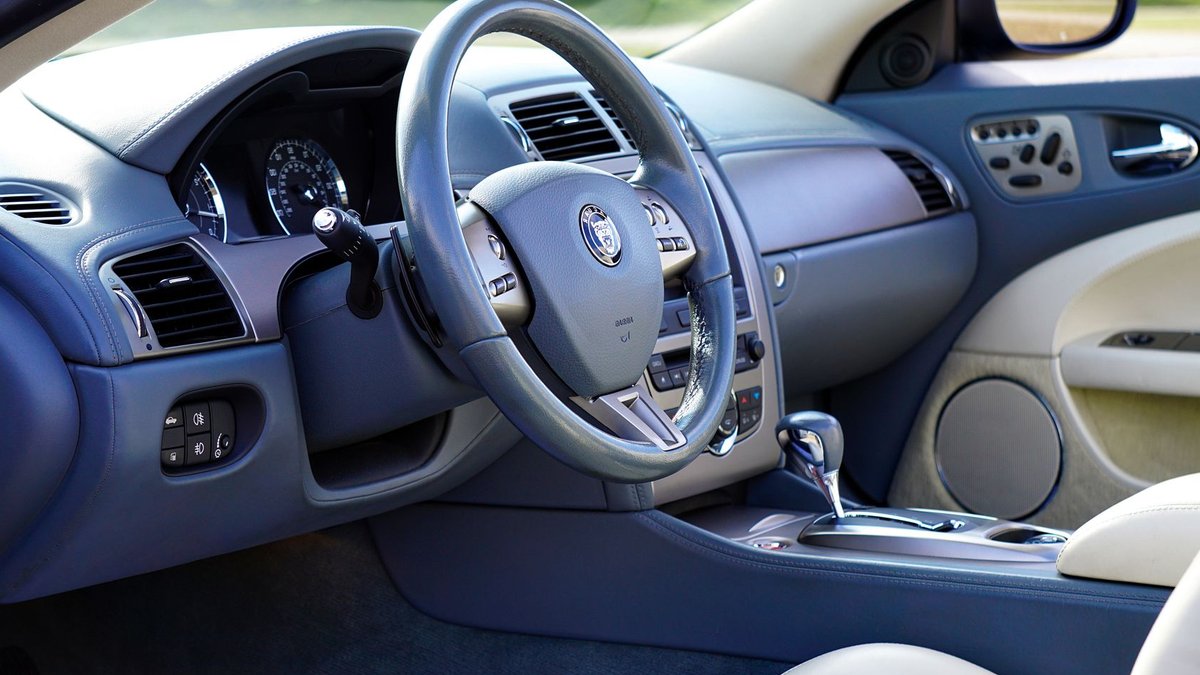
Jaguar has officially revealed the interior of its controversial Type 01 grand touring sedan for the first time. The design follows the minimalist direction previewed in the divisive Type 00, but it notably shuns the trend toward interiors dominated by screens. While the cabin is not completely screen-free, the manufacturer has whittled their presence down to a specific driver display and a secondary control pod. This approach marks a distinct shift away from the cinema-sized displays that have become standard in many new vehicles.
A Restrained Digital Approach
The Type 01 retains a driver display positioned where a traditional instrument cluster would live. It is visible through the steering wheel and extends closer toward the middle of the car. A secondary screen, which is likely to be the car’s primary interface, sits on a pod mounted to the cabin-dividing center console. This placement puts the interface within reach of both the driver and the passenger.
Rather than the massive displays common in modern vehicles, the Type 01 interface comes in roughly the same dimensions as a smartphone. It is shown solely as an interface for climate and cabin comfort settings. This restriction keeps the digital footprint small and focused on utility rather than spectacle. The interface comes in roughly the same dimensions as a smartphone, with its use shown solely as an interface for climate and cabin comfort settings.
Related: BYD launches bigger Seal 07 electric sedan
Spatial Layout and Architecture
The tall center console of the Type 00 coupe remains a key feature of the new sedan. Jaguar claims that this longitudinal spine creates four individual spaces for the occupants. While the rear seats are not shown in great detail, Jaguar has followed the example set by the Cadillac Celestiq by eliminating any partition or divider between the rear seats and the cargo area.
A full-length glass roof stretches back behind the rear-seat occupants’ heads. However, a traditional rear windscreen is absent from the design. This absence suggests a reliance on rear-view cameras for visibility, a stylistic and functional choice similar to the one found in the Polestar 4.
This decision to limit screen size diverges from the path taken by nearly every other luxury automaker today. Most brands equate luxury with the amount of digital real estate available to the driver. By reversing this trend, Jaguar is attempting to redefine premium interiors through material quality rather than technological saturation, a gamble that relies on buyers being tired of touch-heavy controls.


